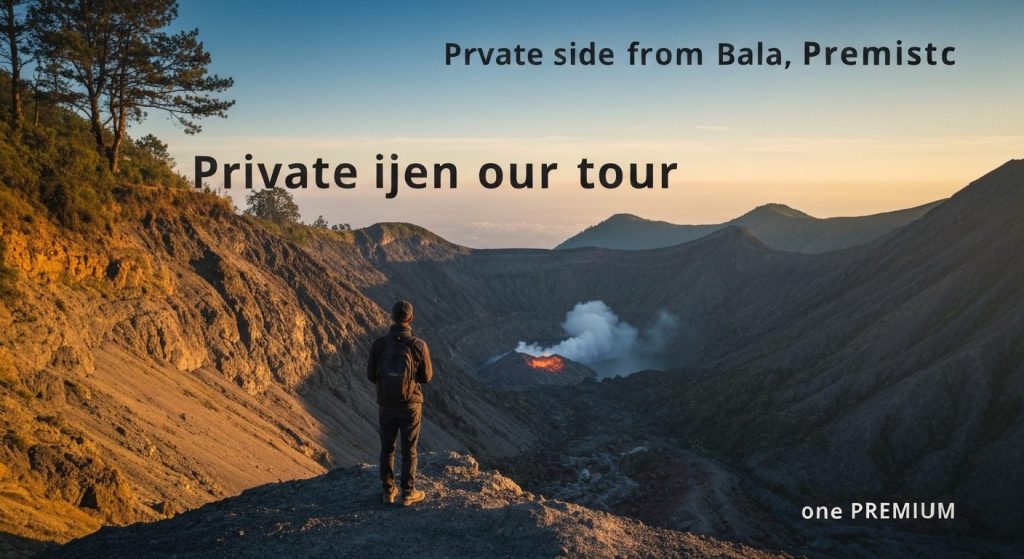
A private ijen tour from Bali is a door-to-door overnight trip from your Bali hotel to East Java, with your own vehicle and licensed guide, to see Kawah Ijen’s blue fire and crater lake at your pace. On this page I’ll explain exactly how that works, what you really sign up for physically and logistically, and how private vs group Ijen tours from Bali compare so you can decide calmly, not on hype.
I’m Bayu, the Photography & Night-Sky Field Editor for Ijen Tour From Bali at Bali Premium Trip. I shoot the blue flames, the turquoise lake and the sulfur miners several nights a week, so my bias is simple: safe guests, clear expectations, good photos.
—
What “Private Ijen Tour from Bali” Actually Means
Most ads say “private” and then you still end up sharing a van from Bali, or a guide at the crater. That’s not this.
On this Private Ijen Tour from Bali:
– You have your own vehicle in Bali (no waiting for a full van).
– Pickup is from your hotel or villa in major areas (Ubud, Kuta, Seminyak, Canggu, Sanur, Nusa Dua, Jimbaran).
– In Java you’re matched with a licensed, local Kawah Ijen guide — English-speaking, used to night hikes and the gas.
– Your small private group is kept tight: 1–6 people who booked together. No strangers added.
Bali Premium Trip plans and operates the whole chain: Bali drivers, ferry timings, Java transfers, and arrangements with licensed guide partners at Ijen. You book directly with our reservations team; we then arrange third‑party services like park guides, jeeps and permits transparently in your name.
Typical timeline for the classic blue‑fire overnight:
– ~19:00–21:00 — Pickup from your Bali hotel (depending on area).
– ~23:45–01:00 — Arrive at Gilimanuk, board ferry to Java.
– ~01:30–02:30 — Cross to Ketapang, drive to Paltuding trailhead.
– 02:30–03:00 — Briefing, gas masks, start Ijen hike.
– ~04:00 — Reach crater rim (2.8–3 km hike, ~500–550 m elevation gain).
– ~04:15–05:00 — Descend into crater (optional) to view blue fire.
– ~05:30–06:00 — Back on the rim for sunrise over the turquoise lake.
– 07:00–08:00 — Back to base, simple breakfast, return journey.
– Afternoon/early evening — Back at your Bali hotel (depending on traffic and your location).
One long night. No sugarcoating. But if you know the rhythm, you can enjoy it.
—
Why Go Private for Kawah Ijen from Bali?
1. Control over your start time and pickup point
With a private Ijen tour Bali hotel pickup, we adjust times based on where you actually sleep.
– Ubud / Canggu / Seminyak: expect 19:00–20:00 pickup.
– Kuta / Legian / Sanur: usually closer to 20:00.
– Nusa Dua / Uluwatu side: we often start a bit earlier to beat traffic around Benoa.
On shared open trips, the schedule is rigid because the operator has to collect everyone. One flight delay, one guest oversleeping, and your blue fire window shrinks. On a private Ijen tour with guide and driver, we only work with your clocks — if you’re ready early, we can leave; if you need 10 minutes to check gear, nobody else gets annoyed in the van.
2. Flexible pace on the hike — and the choice to go down or not
The hike to the rim usually takes 60–90 minutes, depending on fitness. The path is clear but consistently uphill.
On group tours, guides juggle fast and slow hikers, and often must choose a “group average” pace. That can mean:
– Pushing beginners too hard.
– Slowing down confident hikers and missing the darkest blue‑fire window.
With a private or small group Ijen tour (we keep it at maximum 6 people from Bali), your guide walks at your pace. If you’re a trail runner, you can be at the rim in an hour and have time to descend early into the crater. If you prefer slow and steady with breathing breaks, that’s what you get.
You also decide on the spot, with your guide, whether to descend into the crater for the blue fire. It’s steep volcanic gravel, about 30–40 minutes down, then back up before sunrise. Some guests stay safely on the rim for long exposures of the flames instead. On a private Ijen blue fire tour from Bali, there is no peer pressure to “keep up with the group” — only honest safety calls.
3. Safety and gas management in the crater
This is where a professional licensed Ijen guide Bali English speaking really matters.
The sulfur gas down in the crater shifts fast. Wind can clear the air in seconds or blow a dense cloud across the path. A good guide:
– Reads the wind and decides when to move or wait.
– Keeps you upwind of the densest smoke as far as possible.
– Knows alternate spots to stand for photos if your first angle gets gassed out.
In large mixed groups, guides are sometimes stretched thin — one person panics, another wanders toward the fumes for a selfie, and focus fractures. In a private or 4–6 person group, your guide’s eyes are mostly on you.
We arrange proper gas masks, not just thin paper masks. You’ll still smell sulfur; this is not a sealed lab. But your lungs and throat are protected enough to move calmly and pay attention to your footing and your camera.
4. Photo time that isn’t rushed
I’m biased here as a photographer, but the difference is real.
For blue fire:
– You need 10–15 unhurried minutes to dial in your settings (typically ISO 3200–6400, f/2.8–4, 1–2 seconds on a tripod).
– You want the guide to help you find a stable rock, away from the brightest miners’ lamps, and shield your tripod from people bumping it.
For sunrise at the rim:
– You might want to walk 5–10 minutes along the rim to a quieter vantage point with fewer headlamps in your frame.
– You may decide to stay an extra half hour, waiting for the crater lake color to pop once the sun is slightly higher.
On shared tours, departure down the mountain is often fixed to a timeframe (“We leave at 06:00 sharp”), driven by bus schedules. On an Ijen private tour with guide and private vehicle, you and your guide agree on a realistic descent time based on how you feel, how busy the trail is, and your camera goals.
—
Private vs Group Ijen Blue Fire Tour from Bali: Honest Comparison
Here’s a direct look at private vs shared/open‑trip options for Kawah Ijen from Bali.
| Aspect | Private Ijen Tour from Bali | Shared / Open Group Tour |
|---|---|---|
| Group size | 1–6 people (your own group only) | Typically 10–20 guests per bus/van |
| Pickup | Direct from your hotel/villa in main Bali areas | Set meeting points or multi‑stop pickup rounds |
| Vehicle | Own vehicle private Ijen tour Bali (no strangers) | Shared minibus with other travellers |
| Schedule | Flexible within ferry & park hours; tailored to your pace | Fixed timeline; must wait for whole group |
| Guide attention | Dedicated guide for your small group | One or two guides for the entire group |
| Photo support | Guide can help you choose spots & wait for shots | Limited; priority is keeping group together |
| Cost | Higher per person, especially for 1–2 guests; better value for 4–6 | Lower per person; less flexibility |
| Comfort | More legroom, quieter, easier to rest in car | More crowded, varied expectations & noise |
| Risk of “rushed” tour | Lower — schedule set around your group | Higher — one delay can compress blue fire time |
Is a private guide worth it for Kawah Ijen hike? If you care about flexible timing, photography, breathing space, and not being dragged or rushed along the trail, then yes, the extra budget usually returns in actual experience, not just comfort.
Indicative pricing (last verified June 2026):
– Private Ijen tour from Bali for 2 guests typically lands around **US$220–320 per person**, depending on season, hotel pickup area and exact inclusions.
– For a small private group of 4–6, it can drop closer to **US$150–220 per person**.
Shared tours from Bali can be lower, in the **US$120–190 per person** range, but at the trade‑offs described above. These are indicative ranges, not fixed quotes; our reservations team will give you an exact figure once we know your dates, pickup address and group size.
—
Where We Pick You Up in Bali — And How the Logistics Work
Covered pickup areas and realistic timings
We offer Ijen tour pickup from hotel Bali in these main zones:
– Ubud central and nearby villages
– Kuta, Legian, Seminyak, Canggu
– Sanur and Denpasar area
– Jimbaran, Nusa Dua, Tanjung Benoa
– (On request, with adjusted timing) Uluwatu / Balangan / Bingin
Long story short: the farther you are from Gilimanuk ferry port, the earlier we need to start. From Ubud or Canggu, the drive can be 3–4 hours at night; from Jimbaran or Nusa Dua, add another 30–45 minutes.
We don’t promise “short transfers” because that would be lying. What we can do is:
– Send a comfortable vehicle with a driver used to night runs.
– Plan rest stops for toilets and snacks.
– Keep the group small so you can actually sleep between stops.
The Bali–Java ferry crossing (Gilimanuk–Ketapang)
From Bali we drive to **Gilimanuk Port**, then take a public ferry to **Ketapang** in East Java. Ferries run 24 hours, usually every 30–60 minutes at night. Crossing time is roughly 45–60 minutes, but include loading/unloading and you can easily spend 90 minutes dock‑to‑dock.
Important to know:
– Ferries are functional, not fancy. Think benches, basic toilets, fluorescent lights, sometimes loud TVs.
– Sea conditions are usually calm in the Bali Strait, but I still recommend motion sickness pills if you’re sensitive.
– Your driver stays with the vehicle; you can nap in the car or go up to the deck for fresh air.
Bali Premium Trip arranges the ferry tickets and handles the vehicle procedures. You just follow us on board.
Arrival in Java and transfer to Kawah Ijen
At Ketapang we drive inland toward **Paltuding**, the official Kawah Ijen trailhead, at about 1,800 m above sea level. The drive is 1.5–2 hours at night.
Here we meet your local licensed guide — a Kawah Ijen specialist who hikes the mountain several times a week. They’re the ones who know where the gas can roll, which sulfur miners are open to photographs, and what the latest park rules are. They also hold the permits we arranged for you.
—
The Hike: Fitness, Trail Reality and Safety
Distance, elevation and who this is for
Trail basics:
– Distance from Paltuding to crater rim: ~2.8–3 km one way.
– Elevation gain: around 500–550 meters.
– Typical time: 60–90 minutes up, 45–60 minutes down.
The path is wide and well‑used but quite steep in sections, especially the middle third. It’s not a technical climb, just a sustained uphill walk on volcanic gravel.
Honest answer: if you can walk up a few floors of stairs without collapsing, and you’re fine with a slow pace and breaks, you can usually do this hike. But:
– Asthma, heart conditions or pregnancy: talk to your doctor first and tell us openly; we may advise against the crater descent or the trek altogether.
– Kids: older teenagers who are used to hiking often manage well; young children usually struggle with the night cold and sleep disruption.
Your guide will test your pace early and suggest a rhythm. If, halfway up, you feel it’s too much, staying at a mid‑point shelter is an option — better to sit under the stars than push into a panic attack.
Gas masks, headlamps and what to wear
We arrange:
– Gas masks for each guest (filter type, not simple cloth masks).
– Headlamps — but if you own a bright, reliable one, bring it.
You should bring:
– **Layers**: base layer, light fleece, windproof outer shell. Night temps near the rim can drop to 5–10°C with wind chill.
– **Good shoes**: lightweight hiking shoes or sturdy sneakers with grip. No flip‑flops.
– **Thin gloves and beanie** if you get cold easily.
– **1–1.5 litres of water** per person.
– Light snacks (nuts, chocolate, energy bars).
The crater descent is optional and steeper, with loose rock. If you choose to go down for the blue fire, your guide will walk you in single file, stopping whenever gas thickens.
Is it safe to go into the crater?
This is the question I’m asked the most.
There is risk. This is an active volcanic crater with sulfur gas. The park permits guided visitor access because, managed well, the risk is kept within what most people accept for adventure travel. But it’s not a theme park.
How we reduce risk:
– We only enter the crater when conditions look reasonable — if wind is wrong or gas too dense, we stay on the rim and focus on blue fire shots from above.
– Your guide decides the specific route and when to pause or retreat.
– You must listen when they say “mask on” or “we go back now”, even if you feel like staying for “just one more photo”.
If your lungs or nerves don’t like intense environments, you can skip the descent and still have a rewarding experience with the lake and sunrise.
—
Blue Fire and Sunrise: What You Actually See
How the blue fire works
The blue flames of Kawah Ijen are not magic; they’re sulfuric gases igniting as they escape cracks near the sulfur mine. You see them best:
– In the darkest hours before dawn (roughly 02:30–04:30).
– On dry, relatively wind‑still nights.
– When your eyes are adapted to the dark and camera exposure is set correctly.
From inside the crater you can get very close views of 1–5 meter flames flickering around the pipes where miners work. From the rim, you see a widely glowing area — less dramatic to the naked eye, but very photographable with a tripod.
We can never guarantee the intensity of the blue fire. Some nights it’s vivid and tall; other nights it’s lower and partly obscured by gas. Anyone promising “100% blue fire every night” is selling a fantasy.
Sunrise over the turquoise crater lake
After the blue fire window, we head back toward the rim before dawn. The crater lake — a highly acidic turquoise pool — sits about 200 meters below the rim.
What to expect:
– About 05:30–06:00 the first light reveals the lake and the sulfur mine.
– Between 06:00–07:00, as the sun rises behind the mountains, the color of the lake usually shifts from deep grey‑blue to bright turquoise.
– On clear days you can see the surrounding peaks and, sometimes, a line of clouds below you in the valleys.
Some mornings are cloudier. Sometimes fog drifts in and out, opening and closing the view. Patience helps; often a 5–10 minute wait will give you a clear window.
—
Best Season and Weather Windows for Ijen Blue Fire
Dry vs wet months
East Java’s drier months are typically **May to October**. Nights are cooler and clearer; the chance of heavy rain is lower. For photographers, this is the prime season.
November to April is generally wetter. But that doesn’t mean “no blue fire”:
– Blue fire depends more on gas flow and darkness than on rain.
– Heavy rain can make the path wetter and more slippery.
– Cloud cover can affect sunrise views but doesn’t stop you seeing the flames before dawn.
We don’t shut Ijen tours in rainy months, but we do insist on better footwear, extra layers and a more cautious pace.
Wind and gas conditions
Wind direction changes night to night. Even in dry season, you can have a gassy crater where we choose to avoid going too deep. Conversely, on a good night in shoulder season, wind can keep the crater remarkably clear.
I can’t forecast gas for your exact date. Nobody can long‑range. What we can promise:
– We check recent conditions with our on‑ground guides before confirming your hike window.
– If Ijen is temporarily restricted by park authorities for safety reasons (it happens occasionally), we follow the rules and adjust plans or reschedule.
—
Photographing Kawah Ijen — With Respect
Blue fire camera basics
For the night flames:
– Camera: DSLR or mirrorless with decent high‑ISO performance.
– Lens: fast wide‑angle (e.g. 14–24mm, f/2.8 or faster).
– Settings starting point: ISO 3200–6400, f/2.8–4, shutter 1–2 seconds.
– Tripod: essential for clean shots; lightweight, stable legs.
Your guide can help you find a spot where tripod legs are stable and foot traffic minimal. I’ll be honest: conditions are messy. There’s gas, moving miners, other visitors and uneven rocks. Expect some failed shots — that’s normal.
Sunrise and crater lake compositions
On the rim, I suggest:
– A mid‑wide lens (24–35mm) to balance the lake, rim and distant peaks.
– Bracketing exposures if you’re comfortable with it; the contrast between sky and crater can be high.
– Arriving at least 20–30 minutes before official sunrise to watch colors evolve.
Again, on a private Ijen tour with experienced guide, you can ask to walk a little further along the rim for a cleaner angle or fewer people in frame.
Photographing sulfur miners ethically
The miners are working in harsh conditions for modest pay. They are not props.
Guidelines we follow and ask guests to respect:
– Do not shove a camera in a miner’s face without permission, especially in the gas.
– If a miner is clearly busy wrestling baskets or coughing, leave them alone.
– If a miner makes eye contact and seems open, a simple gesture to your camera with a questioning look goes a long way. Many understand and will nod or shake their head.
– Tipping for posed portraits is common and appreciated. Your guide can advise a fair, respectful amount in local currency.
Some of the best images I’ve seen are taken from a respectful distance with a longer lens, capturing the scale of the work — tiny human figures under a huge crater wall — rather than close‑up suffering.
—
What’s Included in a Private Ijen Tour from Bali with Bali Premium Trip
Because we arrange each trip based on your location and group size, specifics can vary, but in general a private Ijen tour from Bali with us covers:
Typically included
– **Private vehicle & driver in Bali** from your hotel and back.
– **Ferry tickets** for you and the vehicle Bali–Java–Bali.
– **Private transfer in Java** from Ketapang port to Kawah Ijen trailhead and return.
– **Licensed local Ijen guide**, English‑speaking, dedicated to your group.
– **Entrance fees & permits** for Kawah Ijen National Park (as per latest regulations).
– **Gas masks and headlamps** for use during the hike.
– Simple **coffee/tea and light breakfast** after the climb.
Common exclusions
– Main meals in transit (we stop at local warungs or simple cafes; you pay what you order).
– Personal hiking gear and clothing.
– Travel insurance (we strongly recommend you arrange your own).
– Optional tips for guides, drivers and miners.
Indicative total trip duration from Bali hotel to back again is around **18–24 hours**, depending on your starting area and traffic.
—
How to Decide if This Trip Is Right for You
A private Ijen tour from Bali is a good fit if:
– You’re okay with one long, disrupted night and a big sleep the day after.
– You want to control your pace and not be dragged by a large group.
– You care about photography or just quiet moments at the rim.
– You appreciate having an accountable team from Bali to the crater rim, not a patchwork of separate bookings.
It might not be the right choice if:
– You dislike overnight travel and strongly prefer normal sleep patterns.
– You have serious respiratory or heart issues.
– You’re looking mainly for a casual beach holiday with no intense days.
If you’re unsure, send us a message and describe your fitness honestly — we’d rather tell you “maybe not” than push you into a miserable night.
Mid‑way through planning and have questions already? You can always plan your trip with our team via email or WhatsApp — we’ll walk you through timing, fitness and camera needs before you commit.
—
Booking Direct with Bali Premium Trip
Bali Premium Trip is the Bali‑side concierge and organiser behind Ijen Tour From Bali. We:
– Coordinate Bali drivers, ferries and Java transfers under one plan.
– Arrange licensed Kawah Ijen guides, permits and equipment on your behalf.
– Keep communication in one thread — usually email plus WhatsApp while you’re on the road.
You book directly with our reservations team at transparent, published rates; there is no extra markup from middlemen. If we use any third‑party services (like local guide cooperatives or park jeeps), they’re simply part of the chain we manage for you.
Before confirming, we’ll ask:
– Your Bali hotel or villa address.
– Your preferred date window (plus one backup night if possible — helpful in rainy season).
– Group size and rough fitness level.
– Any medical notes we should be aware of.
Then we send you an itinerary with pickup time, indicative schedule, inclusions and price range for your specific case. If it feels right, we lock it in and start preparing your guide and gear.
To start that conversation, just plan your trip — mention “Private Ijen Tour from Bali” and, if you’d like, ask for WhatsApp follow‑up so we can iron out details in real time.
—
How long is the private Ijen tour from Bali?
Door to door, expect around 18–24 hours. Most pickups are between 19:00–21:00 on day one, with you back at your Bali hotel by late afternoon or early evening the next day, depending on your location and traffic.
Can I join this tour from Ubud, Kuta or Seminyak?
Yes. We regularly run Ijen tour from Ubud, Kuta, Seminyak, Canggu, Sanur, Jimbaran and Nusa Dua with direct hotel pickup. The main difference is your pickup time: Ubud and Canggu usually start a bit earlier than Kuta or Sanur to allow for a longer drive to the ferry.
Do I really need a private guide, or can I just follow the crowd?
The path to the rim is obvious, and in high season many people are on it. But a private, licensed Ijen guide adds value once you reach the gas zone and the crater. They read wind and fumes, manage timing for blue fire, help with safe footing in the dark, and advocate for your pace instead of the crowd’s. For first‑timers, that safety and calm usually justifies going private.
Will I definitely see the blue fire?
No one can promise that. On most clear, dry nights the blue fire is visible, but its intensity and visibility change with gas flow, wind and moisture. Some nights it’s very strong and clear; other nights the flames are partly hidden by thick gas or rain. We plan your timing around the best odds but never guarantee a specific natural phenomenon.
Is the tour suitable for people with asthma or heart conditions?
It depends on severity, but many guests with respiratory or cardiac issues are better avoiding the crater descent or the hike altogether. The climb is steep, at altitude, and sulfur gas is present even with masks. You must consult your doctor before booking and share their advice with us; based on that, we may recommend staying on the rim only, choosing a different activity, or not going to Ijen for your own safety.