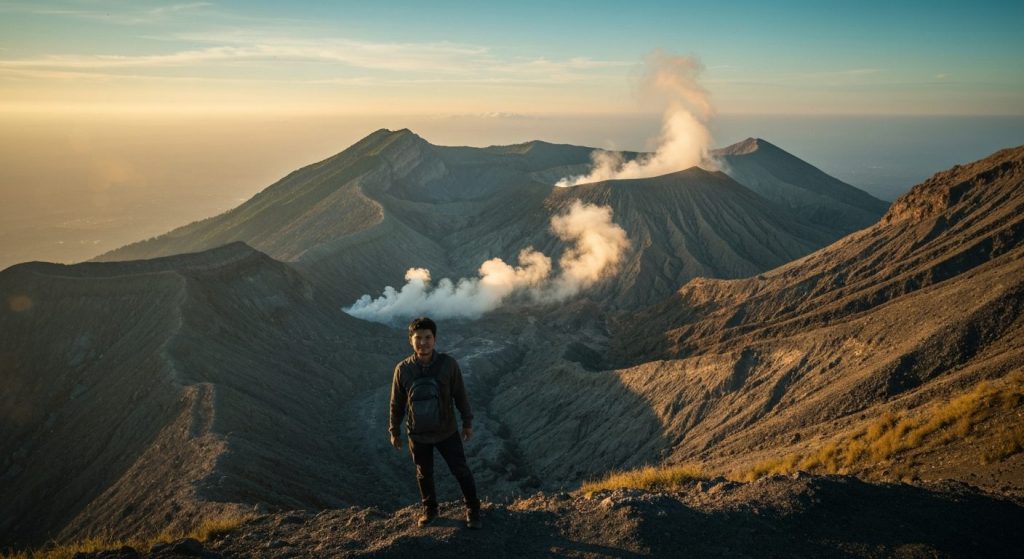
An ijen tour from banyuwangi means starting your Kawah Ijen hike from the closest East Java town to the crater, usually with a midnight pickup and a 20–40 minute drive to the trailhead at Pos Paltuding. It’s the most time‑efficient way to reach the blue fire and turquoise crater lake, and it’s the starting point I recommend if you’re already on the East Java side or arriving via the Ketapang ferry from Bali.
I’m Bayu, Photography & Night-Sky Field Editor at Ijen Tour From Bali (operated by Bali Premium Trip). I hike Kawah Ijen several nights every month, mostly to shoot the blue flames and the crater lake — and to keep our information honest and current.
This page is your comparison hub for four entry points: Banyuwangi, Bondowoso, Surabaya, and the Ketapang ferry gateway that connects Bali to East Java. No marketing fog, just real drive times, typical costs, and what each route feels like at 01:30 in the morning.
—
## Ijen from the East Java side vs from Bali: how this page fits
My speciality is arranging full‑chain Ijen trips from Bali — hotel pickup on the island, ferry at Ketapang, guided crater hike, then back to Bali or onward into Java. But many people:
– Are already in East Java (Banyuwangi, Bondowoso, or Surabaya), or
– Want to compare an ijen tour from surabaya vs from bali, or
– Plan to cross the Ketapang ferry to ijen gateway from bali on their own, then meet a guide.
So this page does two things:
1. Compares the main East Java starting points — Banyuwangi, Bondowoso, Surabaya.
2. Shows how the Ketapang ferry acts as a bridge for Bali‑based travelers who still want a Bali Premium Trip‑run blue‑fire trek.
For Bali‑departure logistics specifically, I keep a separate deep‑dive page. Here we stay focused on the East Java side.
—
## Overview: Four ways to reach Kawah Ijen
Here’s the high‑level comparison before we zoom in.
| Starting point | Typical drive to Pos Paltuding | Pickup window for blue fire | Best for |
|---|---|---|---|
| Banyuwangi town | ~20–40 minutes | 23:30–01:00 | Shortest night, most flexible timing |
| Ketapang ferry area (Java side) | ~45–60 minutes | 23:00–00:30 | Direct arrivals from Bali |
| Bondowoso | ~2.5–3.5 hours | 21:00–23:00 | Those touring East Java highlands |
| Surabaya | 8–10 hours by road to Ijen region | Usually multi‑day trip | Combining Bromo + Ijen over 2–3 days |
All routes converge at the same place: the Pos Paltuding trailhead (around 1,800 m). From there it’s a 2.8–3 km hike up, then a steeper descent into the crater if conditions allow.
—
## Ijen tour from Banyuwangi: the closest, calmest start
If you remember only one thing, remember this: a kawah ijen tour from banyuwangi is the most efficient way to see the blue fire if you’re already in East Java.
### Drive time and pickup window
From Banyuwangi town (Ketapang, Kalipuro, central Banyuwangi):
– Drive to Pos Paltuding: usually 20–40 minutes, depending on your hotel and traffic.
– Typical pickup time: between 23:30 and 01:00 for an ijen blue fire tour from banyuwangi.
The park usually opens the gate around 01:00–02:00 for blue‑fire access. We time your pickup back from that. If conditions are unstable (strong sulfur gas, heavy rain), rangers may delay or restrict crater access; in those cases we still hike to the rim for sunrise.
### Why Banyuwangi works so well
Three reasons I personally like starting from Banyuwangi:
1. **Short night** – You can still have dinner and a proper shower, then sleep again after sunrise.
2. **More flexibility** – If weather shifts, we can adjust by 30–60 minutes without wrecking the plan.
3. **Easy logistics** – Banyuwangi to kawah ijen transport and entrance fee are straightforward to arrange on short notice in town.
For a typical private Banyuwangi‑based package that includes transport, licensed local guide, gas masks, and simple crater snacks, people usually end up in the region of **US$80–150 per person** on a two‑person basis (indicative range, varies by season and group size, last verified June 2026). Entrance fees and optional extras sit on top of that and are paid at the park or bundled transparently.
### Kawah Ijen tour from Banyuwangi: what’s actually included?
With Bali Premium Trip, an ijen tour from banyuwangi typically covers:
– Private car + driver from your Banyuwangi accommodation to Pos Paltuding and back
– Licensed local crater guide (mandatory for entering the crater at night)
– Gas mask use for the blue‑fire section
– Headlamps if you don’t have one (though I recommend bringing your own with fresh batteries)
What is **not** automatically included:
– Park entrance fees (day vs night rates differ and are set by the authorities; typical foreign visitor ranges as of June 2026 are roughly US$10–25 per person, subject to change)
– Optional porter services
– Your accommodation in Banyuwangi town
We don’t own the national park. We arrange jeeps where needed, pay the official entrance, and line up the guides we trust. You always see what’s park fee and what’s our service.
### Photography & blue fire from Banyuwangi
If you’re serious about shooting the blue fire:
– Aim for a **moonless or low‑moon night**. Bright full moons wash out the flames in long exposures.
– From Banyuwangi we can be at the gate early, which increases the chance to reach the flames before crowds.
– For the blue flame itself, I usually work around **ISO 3200–6400, f/1.4–2.8, 4–10 seconds**, tripod‑mounted. Handheld phone shots will record something, but not what you’ve seen online.
From Banyuwangi, I can more easily arrange a slightly earlier departure to give you time to set up a tripod away from the main line of visitors, without getting in the miners’ way.
—
## Ijen tour from Bondowoso: Pos Paltuding from the highland side
An ijen tour from bondowoso approaches Kawah Ijen from the west, still ending at the same Pos Paltuding trailhead. This is the classic kawah ijen tour from bondowoso via pos paltuding, often combined with coffee plantations and waterfalls nearby.
### Drive time and road conditions
From Bondowoso town to Pos Paltuding:
– Expect **2.5–3.5 hours** of driving along winding highland roads.
– Pickup for blue fire usually between **21:00 and 23:00**.
The road is paved but can be narrow and foggy at night. Your driver needs to be rested and familiar with the route; this isn’t the place for an experiment with a random, sleepy driver.
### Who should start in Bondowoso?
Bondowoso is a good start if:
– You’re already exploring East Java highlands and coffee areas around Bondowoso.
– You plan to drive **onwards to Banyuwangi** after the hike (Bondowoso → Ijen → Banyuwangi is a common loop).
– You prefer a quieter town before the hike compared to the ferry area.
Bondowoso is **not** ideal if you’re short on sleep or travelling with small kids. The earlier night departure can be hard on families.
In terms of budget, typical private trips from Bondowoso including transport, guide and masks often land slightly higher than Banyuwangi because of the extra driving distance — think **around US$90–180 per person** on a two‑person basis (indicative, not a fixed quote, last checked June 2026), plus variable park entrance.
### Bondowoso vs Banyuwangi for Kawah Ijen
- Drive length
- Banyuwangi: 20–40 min. Bondowoso: 2.5–3.5 hours.
- Night start
- Banyuwangi: around midnight. Bondowoso: typically late evening.
- Best combined with
- Banyuwangi: ferry from Bali, coastal stays. Bondowoso: highlands, coffee, waterfall circuits.
- Fatigue factor
- Banyuwangi: lighter. Bondowoso: heavier, especially after the hike when you still have a long drive.
Many of our guests choose to **start in Bondowoso and end in Banyuwangi**, or the other way around, depending on the rest of their Java route. We build that in when you plan your trip with our team (WhatsApp is usually the fastest way to go back‑and‑forth on timing and hotel pickups).
—
## Ijen tour from Surabaya: usually a 2–3 day Bromo + Ijen overland
An ijen tour from surabaya is not a quick side trip; it’s a proper overland journey across East Java. Most people link it with Mount Bromo: a surabaya to ijen crater 3 day bromo ijen tour is the standard pattern.
### Distance and travel pattern
From Surabaya to the Ijen region:
– By road: **8–10 hours** depending on route and traffic.
– Often split into two segments with Bromo in between.
The usual options:
1. **3‑day Surabaya → Bromo → Ijen → Banyuwangi**
– Day 1: Surabaya to Bromo area
– Day 2: Sunrise at Bromo, then long drive to Bondowoso or Banyuwangi
– Day 3: Night/early‑morning hike at Ijen, then drop at Ketapang ferry or Banyuwangi airport
2. **2‑day Surabaya → Ijen → Surabaya/Bali**
– Long and rushed, only really workable if you’re okay with very little sleep and minimal stops.
From a photography and comfort standpoint, I usually **push for at least 3 days** for a Surabaya–Bromo–Ijen combination. Two days is technically possible but hard on the body.
### Ijen tour from Surabaya vs from Bali comparison
Here’s how starting in Surabaya compares with starting from Bali for those doing both Bromo and Ijen.
| Aspect | From Surabaya | From Bali (via Ketapang) |
|---|---|---|
| Main focus | East Java loop: Surabaya, Bromo, Ijen | Bali stay plus a detour to Ijen |
| Typical duration | 2–4 days overland | 1–2 days from Bali, or longer Bali holiday with 1 Ijen night |
| First big highlight | Bromo sunrise | Ijen blue fire or sunrise, depending on schedule |
| Travel style | Long drives across Java, multiple hotel changes | Base on Bali, one ferry crossing each way |
| Who it suits | People already in Java or flying into Surabaya | People already on holiday in Bali |
Budget‑wise, a **3‑day Surabaya–Bromo–Ijen private trip** with transport, drivers, guides and basic accommodation usually falls in the broader regional range of **US$350–700 per person** for small private groups (again, indicative, last checked June 2026, and very sensitive to hotel category and group size).
Our Bali Premium Trip reservations team can handle both versions — Bali‑based routes and Surabaya‑based overlands — with the same emphasis on clear timing for night drives and crater access.
—
## Ketapang ferry to Ijen: the gateway that links Bali and Banyuwangi
The Ketapang ferry to ijen gateway from bali is the bridge that makes “Ijen from Bali” possible. On the Bali side you start around Gilimanuk at the western tip; on the Java side you arrive at Ketapang, just outside Banyuwangi.
### Typical crossing pattern
– Crossing time: around **45–60 minutes** on the water, plus waiting time.
– Ferries run **24 hours**, though frequencies swing up and down with the time of day.
– You can cross **on foot** or **with a vehicle**.
From Bali, we usually:
– Pick you up by car at your Bali hotel.
– Drive to Gilimanuk (3–4.5 hours from South Bali; 1.5–3 hours from North/West Bali).
– Take the vehicle on the ferry, so you stay with the same driver and guide across islands.
Once you reach Ketapang on the Java side, you are essentially in the Banyuwangi catchment area. It’s then 20–40 minutes to town, or **45–60 minutes** directly up to Pos Paltuding.
### Typical ferry costs and what we arrange
Ferry tickets are set by the transport authorities and ferry operators, not by us. As a ballpark checked in June 2026:
– Foot passenger fares tend to be in the **low single‑digit US$ equivalent** per person.
– Vehicle tickets vary by size and can range from **around US$10–40** equivalent or more for larger vehicles.
These are indicative only and can change without notice. We don’t get a commission on ferry tickets; we simply purchase what’s needed for your itinerary and itemise it.
Bali Premium Trip arranges:
– Your vehicle and driver across both islands (so you don’t need to change cars at the port).
– The timing of the crossing so you still reach Pos Paltuding in time for blue‑fire access.
– A Banyuwangi to ijen blue fire guided tour with gas masks on the Java side, fully briefed and synced with your Bali pickup time.
If you prefer to cross on your own as a foot passenger, we can also meet you on the **Ketapang (Java) side** with a vehicle and guide, then run your ijen tour from banyuwangi as usual.
—
## How early do you really need to start for a blue‑fire tour?
A kawah ijen tour from banyuwangi midnight pickup is common, but the exact time depends on your fitness and priorities.
### Working backwards from the blue fire
The blue flames are most visible in the **deepest part of the night** before nautical twilight washes the glow out. To reach them you:
1. Hike up from Pos Paltuding to the rim: **60–90 minutes** at a moderate pace.
2. Descend into the crater: **30–45 minutes** on steep, dusty, rocky ground.
3. Walk another **5–15 minutes** along the inner path to the flames, depending on where rangers allow access that night.
So we aim to reach Pos Paltuding **1.5–2.5 hours** before the blue fire “window” you’re targeting. On most nights this means getting to the gate around **01:00–02:00**.
Working backwards again:
– From central Banyuwangi: pickup around **23:30–01:00**.
– From Ketapang area: pickup around **23:00–00:30**.
– From Bondowoso: pickup around **21:00–23:00**.
For very fit hikers who only care about sunrise from the rim and not the blue fire, we can schedule a **later start**; but if seeing the flames is important, earlier is safer.
—
## Fitness, altitude and gas masks: who should (and shouldn’t) go
Kawah Ijen is not Everest, but it’s also not a gentle nature walk. I’d rather be upfront so you can decide calmly.
### The hike in simple numbers
– Distance from Pos Paltuding to rim: **about 2.8–3 km** one way.
– Elevation gain: roughly **450–500 m**, starting near 1,800 m and reaching around 2,300–2,400 m.
– Gradient: several long sections at 20–30 degrees, especially the middle third.
At night, the thin air and darkness can make it feel tougher than it looks on a map.
If you go down into the crater:
– The descent is **steeper and rougher** than the main path, with loose rock and sulfur dust.
– You’ll be wearing a gas mask, which can feel claustrophobic for some people.
### Who usually manages fine
Most people who:
– Can walk **uphill for 60–90 minutes** at a steady pace.
– Are comfortable with basic hikes at moderate altitude.
– Have **no serious heart or lung conditions** and no severe asthma.
We go at your pace. I stop often for water breaks (which doubles as a chance to shoot the stars).
### Who should think twice
I’m not a doctor, and we’re not a medical service, but I have seen guests struggle who:
– Have unstable heart or respiratory issues.
– Have uncontrolled vertigo or panic attacks in enclosed or steep environments.
– Are very sensitive to sulfur smells or have a history of severe asthma.
You can still hike to the **rim only**, sit well away from the gas plume, and enjoy sunrise and the crater lake from above. The blue fire is inside the crater and only visible at night, so I only take people down when rangers allow it and it looks safe for your condition on the day.
Gas masks are **mandatory** for anyone entering the crater, and I insist they are worn correctly. They are not a fashion accessory.
—
## Photographing Ijen: rim, blue fire and miners (without being a jerk)
I’m hired mainly for night‑sky and blue‑fire work, but the part I respect most is the sulfur miners. They work incredibly hard for relatively little pay, on terrain where most visitors already feel wobbly with just a camera.
### Where to stand on the rim at sunrise
From the rim, for sunrise and the turquoise crater lake:
– I usually walk **10–15 minutes left** (as you face the crater) from the main viewpoint.
– From there, you get a wider angle on the lake, the sulfur plume, and the silhouettes of people on the ridge.
For cameras:
– Wide lenses around **16–24 mm** (full‑frame) capture the lake and rim.
– Sunrise exposures often sit around **ISO 400–800, f/5.6–8, 1/60–1/250** depending on clouds.
Phones do fine for rim shots if you’re not chasing print‑quality files.
### Blue fire photography basics
Inside the crater, conditions change minute by minute. The flames move. The gas plume shifts. Other visitors’ lights flare into your frame.
My usual starting point:
– **Tripod**: essential if you want more than a memory shot.
– Manual exposure: **ISO 3200–6400, f/1.4–2.8, 4–10 seconds**.
– White balance: set manually around **3,000–4,000 K** so the blue doesn’t turn purple.
Turn your headlamp **off** during the exposure, and be aware of where you put your tripod legs so you’re not blocking the miners’ path.
### Photographing the miners respectfully
There is one simple rule: treat miners as workers, not props.
– Don’t block their path. They carry **60–80 kg** of sulfur on bamboo baskets.
– Ask before putting a camera in someone’s face. A hand gesture and eye contact go a long way.
– Don’t fire a flash at close range in the dark. They still have to walk a treacherous path.
If you want close‑up portraits, I recommend:
– Talk to your guide first. They often know miners personally and can introduce you properly.
– Consider carrying something small and useful (like snacks or cigarettes) as a friendly gesture, **without** turning it into a transactional “pay for a photo” situation.
Your photos should feel like a record of human work in a harsh environment, not a trophy taken at someone else’s risk.
—
## Entrance fees, transport and what Bali Premium Trip actually does
We are not the park authority, and we don’t set the official ticket prices or rules. What we do is line up all the moving parts so your Ijen visit — from Bali, Banyuwangi, Bondowoso or Surabaya — is one coherent plan with one accountable team.
### Entrance fees and park rules
Current patterns (subject to change at any time by the authorities):
– Different rates for Indonesian citizens and foreign visitors.
– Different rates for weekdays vs weekends/holidays.
– A **night/blue‑fire visit** can have a different fee structure compared with a simple daytime rim visit.
As of the last update in June 2026, foreign visitor fees commonly fall somewhere in the **US$10–25 per person** range depending on day and category, but this can change without notice. We always share the latest confirmed rates during trip planning and either:
– Bundle them into your total, or
– Have you pay directly at the official counter, with our guide helping.
### What we arrange (East Java side)
From any of the starting points we’ve discussed, Bali Premium Trip arranges:
– Private vehicles and drivers used to night mountain driving.
– Licensed local guides for Kawah Ijen (mandatory for crater access).
– Gas masks and headlamps when needed.
– Hotel pickups and drops (Banyuwangi, Bondowoso, Surabaya, Ketapang).
– Clear timing so the ferry, road transfers and blue‑fire window all align.
You book **directly** with our own reservations team at Bali Premium Trip; there’s no third‑party markup or referral commission in your price. For any third‑party services (park jeeps, ferries, etc.), we act as your arranger and pay them directly on your behalf, or organise so you can pay them yourself transparently.
If you want us to sketch a route starting in Surabaya, looping Bromo and Ijen, and ending in Bali (or the other way around), just plan your trip with us. WhatsApp usually lets us clarify dates, fitness level and camera goals in a few quick messages rather than long emails.
—
## FAQs: Ijen from Banyuwangi, Bondowoso, Surabaya and Ketapang
Is Banyuwangi or Bondowoso better for Kawah Ijen?
If you want the shortest night and the simplest logistics, Banyuwangi is usually better. Bondowoso works well if you’re already in the highlands or doing a wider East Java loop, but the night drive is 2.5–3.5 hours each way instead of 20–40 minutes.
Can I see the blue fire from the rim only without going into the crater?
On very clear, dark nights you may see a faint blue glow from the rim with a long lens or long exposure, but the intense “blue river” effect is inside the crater. If conditions or your health mean we skip the descent, you still get sunrise and the crater lake from the rim, just not the close blue-fire view.
Is a gas mask really necessary for Kawah Ijen?
For the crater descent and blue fire, yes. Sulfur gas can be extremely irritating and dangerous at high concentrations. A proper mask is non-negotiable for going down. On the rim, many visitors are fine with just a light face covering, but we always carry masks and advise you based on wind and plume conditions.
Can I visit Ijen as a day trip from Surabaya?
Technically you could race there and back, but it would involve extremely long night drives and almost no rest. In practice, Surabaya-based visitors treat Ijen as part of a 2–3 day overland trip, often combined with Bromo. That’s safer, less stressful and gives you a real chance to enjoy both volcanoes.
How far in advance should I book an Ijen tour from Banyuwangi or Bali?
For weekdays outside peak holidays, 3–7 days in advance is often enough from Banyuwangi. For weekends, national holidays, or if you’re planning a Bali + Ijen route with ferries and multiple hotels, 2–4 weeks is more comfortable. The park has capacity limits and some nights book out, so earlier is always better if your dates are fixed.
If you want help weighing Banyuwangi vs Bondowoso vs Surabaya for your specific dates — or fitting Ijen into a Bali stay via Ketapang — send us a note or WhatsApp through plan your trip. I’ll treat your hike like I would my own night up there: honest timing, realistic effort, and a real chance to come home with the views (and photos) you actually care about.