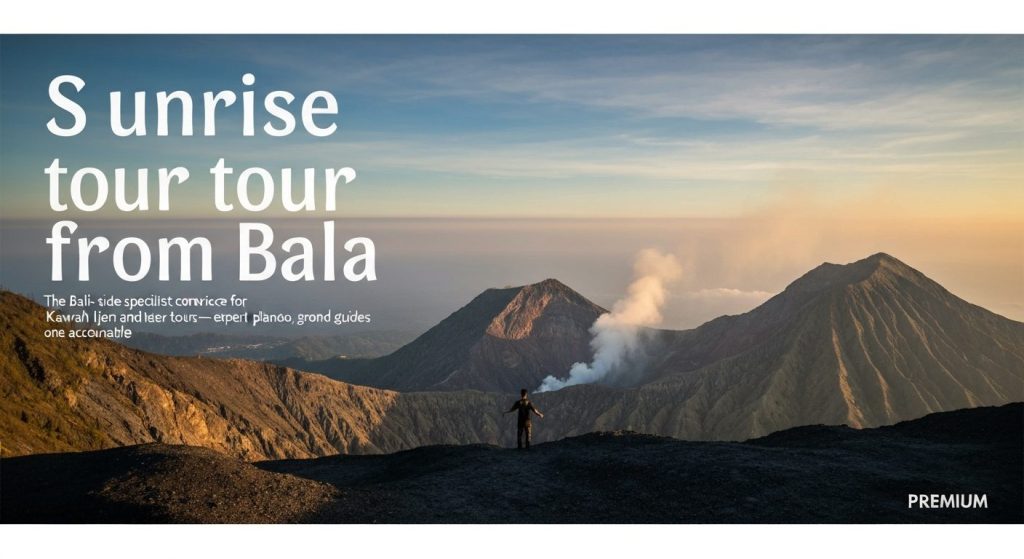
The **Ijen sunrise tour from Bali** offers an unforgettable journey to witness one of Indonesia’s most captivating natural wonders: the Kawah Ijen crater at dawn. As the Photography & Night-Sky Field Editor for Ijen Tour From Bali, I’m Ijen Tour from Bali Editorial Desk, and I’ve spent countless nights and early mornings on this mountain, documenting its shifting moods and helping visitors capture its magic. This page is your candid guide to experiencing the spectacular sunrise over Ijen’s turquoise acid lake, framed by sulfur plumes and the resilient miners who call this place their workplace.
We understand that planning an Ijen adventure from Bali involves many questions, from ferry logistics to camera settings in near-total darkness. Here, I’ll share my trail-tested insights, comparing the iconic blue fire experience with the serene, equally dramatic sunrise, and help you decide which journey is right for you. We’ll cover everything from the best viewpoints to respectful photography practices, all to ensure your **ijen crater sunrise tour from bali** is safe, memorable, and truly impactful.
Ijen Blue Fire vs. Sunrise: Which Experience is Right for You?
Many visitors dream of seeing Ijen’s legendary blue flames. It’s an incredible sight, no doubt. But for some, the midnight hike to the crater floor might be too challenging, or the allure of seeing the world’s largest turquoise acid lake bathed in the golden light of dawn is simply more appealing. We often get asked: “Should I do the blue fire, the sunrise, or both?” Here’s an honest comparison to help you choose.
- Ijen Blue Fire Descent (Midnight Hike)
-
This is the experience you see in many viral photos: a surreal trek down into the crater in the pitch black, guided by the flickering blue flames of burning sulfur.
- Timing: Requires starting the hike around 1 AM from the Paltuding trailhead. You descend into the crater around 2-3 AM.
- Visibility: Blue flames are only visible in near-total darkness, typically between 2 AM and 4 AM. After 4 AM, the rising light diminishes their visibility.
- Difficulty: More challenging. The descent into the crater is steep, rocky, and often slippery. It requires good physical fitness, strong knees, and careful footing. Gas masks are essential due to stronger sulfur gas concentrations at the bottom.
- Photography: Extremely challenging. Requires specialized camera gear (fast lens, tripod) and advanced low-light photography skills. Capturing the blue fire authentically, without over-processing, is a true test.
- Crowds: Can be very crowded, especially on weekends and during peak season, both on the trail and at the crater floor.
- What you miss: The full majesty of the turquoise lake and the surrounding caldera at sunrise. You’ll likely be ascending from the crater floor as the sun rises, or viewing it from a lower, less expansive perspective.
- Ijen Sunrise & Crater Rim Tour (Dawn Light)
-
This tour focuses on experiencing the sunrise from the crater rim, offering panoramic views of the turquoise lake, the sulfur landscape, and the working miners.
- Timing: Starts the hike around 2 AM or 3 AM from Paltuding. You reach the rim before dawn, typically between 4:30 AM and 5:30 AM.
- Visibility: Perfect for viewing the Kawah Ijen crater turquoise lake tour as the light changes from deep blue to emerald green and then golden. Sulfur plumes become visible and dramatic.
- Difficulty: Moderately challenging. The hike to the crater rim is uphill but on a relatively well-maintained path. No steep descent into the crater is required, making it less physically demanding than the blue fire trek. Gas masks are still recommended due to sulfur fumes carried by wind.
- Photography: Offers incredible opportunities for landscape photography as the light shifts. You’ll capture the lake’s vibrant colors, the miners at work, and the vast caldera. Tripod still recommended for early dawn shots.
- Crowds: The rim can still be busy, but generally less congested than the crater floor during blue fire hours. There’s more space to spread out and find your spot.
- What you miss: The intimate, surreal experience of seeing the blue flames up close.
- The Combo: Blue Fire + Sunrise Hike from Bali
-
For the truly adventurous, this option combines both experiences into one epic night.
- Timing: Starts the hike around 1 AM, descends to the blue fire, then ascends to the crater rim for sunrise.
- Difficulty: Very challenging. This is an intense, physically demanding, and lengthy night hike with significant elevation changes and exposure to sulfur gas. It requires excellent fitness and stamina.
- Experience: You get to witness both unique phenomena, but be prepared for exhaustion. It’s a full night of hiking.
- Photography: Demanding. You’ll need to manage gear for both extreme low light and then dawn light, often with little time to change settings or lenses.
Ultimately, if your priority is capturing the iconic turquoise lake at its most vibrant and witnessing the dramatic sweep of the caldera at first light, the **kawah ijen sunrise crater rim tour** is an excellent choice. It’s still an adventure, but one that rewards you with spectacular panoramic views without the added challenge of the crater descent. If you’re physically fit and determined to see the blue fire, the combo is for you.
Your Journey from Bali: The Ketapang Ferry and Beyond
Beginning your Ijen adventure from Bali means an overnight journey, primarily involving a ferry crossing. Bali Premium Trip specializes in seamless, private transfers from your accommodation in Bali all the way to Ijen and back.
The Drive to Gilimanuk and Ferry Crossing
Your private driver will pick you up from your hotel in South Bali (e.g., Seminyak, Canggu, Ubud, Sanur) late in the evening, typically between 6 PM and 9 PM, depending on your exact location and the Ijen tour option you’ve chosen. The drive to Gilimanuk Port, located on Bali’s western tip, takes approximately 3-5 hours. It’s a comfortable ride in an air-conditioned vehicle.
Upon arrival at Gilimanuk, your driver will assist you with tickets and boarding the public ferry to Ketapang Port in Banyuwangi, East Java. The ferry crossing itself is usually around 45-60 minutes, though boarding and disembarking can add to the total time. These ferries operate 24/7, making overnight travel straightforward.
Once you disembark at Ketapang, your Bali Premium Trip driver will be waiting to take you directly to the Paltuding ranger post, the starting point for the Ijen hike. This drive typically takes another 1.5-2 hours, winding through plantations and small villages.
Rest Stop or Direct Hike?
Depending on your tour choice and arrival time at Ketapang, you might have a brief opportunity for a coffee or a quick snack before heading to Paltuding. For those doing the blue fire and arriving very early, a short rest at a local homestay before the hike is an option we can arrange, though most prefer to head straight to the mountain to maximize the blue fire viewing window. For the sunrise-only tour, arriving a bit later allows for a slightly more relaxed pace to Paltuding.
The Kawah Ijen Crater Rim Night Hike Sunrise: What to Expect
The hike to the crater rim is a significant part of the Ijen experience. It’s challenging, but immensely rewarding.
Ijen Sunrise Hike Difficulty: Is It For Me?
The hike to the crater rim from Paltuding is approximately 3 kilometers (about 1.86 miles) one-way, with an elevation gain of around 400 meters (about 1,300 feet). The trail is mostly a wide, well-worn path, though it gets steeper in sections, particularly towards the end. It’s classified as moderately difficult.
* **First section (1.5 km):** This is the steepest part, a consistent uphill climb. You’ll gain significant elevation here.
* **Second section (1.5 km):** The trail levels out somewhat, offering a bit of a reprieve before the final push to the rim.
Most people with a reasonable level of fitness can complete the hike in 1.5 to 2 hours. Our licensed local guides set a comfortable pace, ensuring you have time for breaks and to catch your breath. Remember, you’ll be hiking in the dark, so a headlamp is essential.
Factors influencing difficulty:
* **Altitude:** Kawah Ijen’s summit is at 2,799 meters (9,183 feet) above sea level. While the hike starts at Paltuding (around 1,850 meters), the significant altitude gain can make breathing harder for some.
* **Sulfur Fumes:** The presence of sulfur dioxide gas can be irritating to the respiratory system and eyes. This is why gas masks are mandatory and provided by Bali Premium Trip. Winds can shift, bringing fumes across the trail. Your guide will advise on when to wear your mask.
* **Temperature:** It gets very cold on the mountain before dawn, often close to freezing or even below. Layering is key.
If you have any respiratory or heart conditions, or are unsure about your fitness level, please consult your doctor before planning this trip. Your safety is our top priority.
What to Wear Ijen Sunrise Tour: Essentials for Comfort and Safety
Being prepared for Ijen’s conditions is crucial. Here’s my checklist:
* **Warm Layers:** Absolutely essential. It’s freezing on the mountain before sunrise. Think thermal base layers, a fleece jacket, a windproof and waterproof outer shell. A warm hat, gloves, and a scarf are non-negotiable. I usually wear three to four layers.
* **Sturdy Hiking Shoes:** The trail can be uneven, rocky, and slippery, especially if it has rained. Good ankle support is a major plus. Leave your sandals and fashion sneakers at the hotel.
* **Comfortable Hiking Pants:** Avoid jeans, which can be restrictive and uncomfortable when wet or cold.
* **Headlamp/Flashlight:** The trail is unlit. While your guide will have one, it’s always good to have your own. We provide these as part of your tour package.
* **Gas Mask:** Provided by us. Do not attempt the hike without one. Your guide will instruct you on proper use.
* **Small Backpack:** To carry water, snacks, extra layers, and your camera gear.
* **Water Bottle:** Stay hydrated.
* **Snacks:** Energy bars, fruit, or chocolate are great for a quick boost.
* **Personal Medications:** If you require any.
* **Sunscreen and Sunglasses:** Once the sun is up, the glare off the lake and landscape can be intense.
* **Camera Gear (Optional but Recommended):** See my photography tips below!
Leave valuables and unnecessary items at your hotel in Bali. Pack light for the hike itself.
Capturing the Magic: Bayu’s Photography Tips for Ijen Sunrise
As someone who photographs this place for a living, I can tell you that Ijen at sunrise is a photographer’s dream. The light changes dramatically, revealing new colors and textures with every passing minute. Here’s how to capture it like a pro.
Camera Settings for Dawn and the Turquoise Lake
You’ll be shooting in low light initially, transitioning to bright daylight.
* **Pre-Sunrise / Blue Hour (around 5:00 AM – 5:30 AM):**
* **Tripod:** Non-negotiable for sharp images in low light.
* **ISO:** Start at 400-800, adjust higher if needed (but try to keep it below 1600 to minimize noise).
* **Aperture:** f/8 to f/11 for good depth of field, ensuring both foreground and the distant lake are sharp.
* **Shutter Speed:** This will vary significantly. In very low light, you might be looking at exposures of 1-5 seconds or even longer. Use your camera’s light meter or take test shots.
* **White Balance:** Auto White Balance (AWB) works well, but trying ‘Daylight’ or ‘Cloudy’ can sometimes yield warmer, more pleasing tones. Shooting RAW gives you maximum flexibility to adjust this later.
* **Focus:** Manual focus is often best in low light. Focus on a bright point (like a distant headlamp) or use your camera’s live view to zoom in and manually focus on the horizon.
* **Sunrise (around 5:30 AM – 6:30 AM):**
* As the sun rises, the light will increase rapidly. You’ll need to adjust your settings quickly.
* **ISO:** Drop this down to 100-200.
* **Aperture:** Still f/8 to f/11 for landscapes.
* **Shutter Speed:** Will become much faster, perhaps 1/60th of a second up to 1/250th of a second.
* **Graduated Neutral Density (GND) Filter (Optional but recommended):** If you have one, a soft-edge GND filter can help balance the bright sky with the darker foreground, preventing blown-out highlights in the sky.
* **Post-Sunrise / Full Daylight (from 6:30 AM onwards):**
* The lake will be bathed in full sunlight, revealing its incredible turquoise and emerald hues.
* **ISO:** 100.
* **Aperture:** f/8 to f/16 for maximum sharpness across the entire scene.
* **Shutter Speed:** Fast enough to handhold, 1/125th to 1/500th of a second.
* **Composition:** Look for leading lines, rule of thirds, and foreground elements like sulfur rocks or miners to add depth.
**My Pro Tip:** Shoot in RAW format. It gives you so much more flexibility in post-processing to recover details in shadows and highlights, and fine-tune colors.
Where to Stand on the Rim at Sunrise: Best Viewpoints
The **best viewpoint at ijen crater lake sunrise** depends on what you want to capture. The crater rim offers a long stretch, but here are my favorite spots:
* **The Main Viewpoint (Near the “Welcome to Ijen” sign):** This is the most popular spot, offering a wide, unobstructed view of the entire lake and the sulfur activity. It gets crowded, so arrive early if you want a prime spot. The sunrise directly behind the opposite rim often creates beautiful sunbursts.
* **Further Along the Rim (towards the left, facing the lake):** If you walk a bit further along the rim to the left (away from the blue fire descent path), you’ll find slightly less crowded areas. The perspective is still excellent, and you might get a cleaner shot of the lake without as many people in your frame. This area is great for wider panoramas.
* **The Blue Fire Descent Path (from above):** Even if you don’t descend for the blue fire, standing at the top of the descent path just before sunrise offers a dramatic view looking down into the crater. You might catch lingering smoke plumes or even faint blue flames if you’re early enough, along with the full sweep of the lake. Be mindful of hikers coming up from the crater floor.
**My Pro Tip:** Don’t just face the sunrise. Turn around! The light illuminating the landscape behind you, the caldera walls, and the path you just hiked can be equally beautiful and often less photographed.
How to Photograph the Sulfur Miners Respectfully
The sulfur miners of Ijen are truly extraordinary, enduring incredibly harsh conditions to extract sulfur. Photographing them requires sensitivity and respect.
* **Ask for Permission:** Always, always ask for permission before taking a close-up photo of a miner. A simple nod, a gesture, or a “Permisi, boleh foto?” (Excuse me, may I take a photo?) goes a long way. If they decline, respect their wishes immediately.
* **Maintain Distance:** Avoid getting too close or obstructing their path. They are working, often carrying heavy loads (up to 80-100 kg), and their safety is paramount.
* **Offer a Small Token (Optional):** Some photographers choose to offer a small monetary tip (e.g., IDR 10,000-20,000) as a gesture of appreciation if they have taken a portrait. This is not mandatory, but it’s a common practice. Never make it a transaction for a photo; offer it respectfully after the interaction.
* **Focus on Their Work, Not Just Their Face:** Capture the context of their labor – the baskets, the smoke, the arduous trail. This tells a more complete and empathetic story.
* **Don’t Glamorize:** Be mindful not to romanticize or sensationalize their difficult work. The aim is to document their reality with dignity.
* **Engage with Your Guide:** Your local guide can often facilitate respectful interactions and translation, making the experience more meaningful for everyone.
Remember, you are a visitor in their workplace. Be humble, be respectful.
When to Visit: Best Season and Weather Windows
The **best season to visit Ijen** for optimal conditions is during the dry season, which typically runs from April to October.
* **Dry Season (April – October):**
* **Pros:** Clearer skies, less chance of rain, better visibility for both blue fire and sunrise. Trails are less slippery. This is when the blue flames are most visible due to less cloud cover and fog.
* **Cons:** Can be more crowded, especially July-August (peak holiday season).
* **Wet Season (November – March):**
* **Pros:** Fewer crowds.
* **Cons:** Higher chance of rain, fog, and cloud cover, which can obscure views of the lake and sunrise. Trails can be very muddy and slippery, increasing the **ijen sunrise hike difficulty**. Flash floods are also a rare but possible concern during heavy downpours. Park closures due to adverse weather or volcanic activity are more likely.
**Weather Windows:** Even during the dry season, Ijen’s weather can be unpredictable. Mornings are generally clearer. Aim for a night with a clear sky forecast for the best chance of a spectacular sunrise. We continuously monitor weather conditions and local park advisories to ensure your trip is timed for the best possible experience.
Volcanic activity is also a factor. Kawah Ijen is an active volcano. While major eruptions are rare, gas emissions can sometimes be higher, leading to temporary trail closures or restrictions on descending into the crater. Bali Premium Trip stays in close communication with park authorities and local guides to ensure we have the most up-to-date information for your safety.
Your Private Ijen Sunrise Tour from Bali with Bali Premium Trip
When you book your **private ijen sunrise tour from bali** with Bali Premium Trip, you’re choosing a dedicated, experienced team that handles every detail from your hotel in Bali to the Kawah Ijen crater rim and back. We’ve been operating out of Kuta, Bali, since 2015, building a reputation for honest, reliable, and well-organized tours.
One Accountable Team from Bali to the Rim
Unlike some operators who hand you off to various third parties, we provide a consistent, accountable service. Our own Bali-based team manages all communication and planning. We then work with a network of licensed, vetted local guides and drivers in East Java. These local partners are experts in the terrain and conditions of Ijen, ensuring your safety and enhancing your experience with their deep knowledge.
We handle all the logistics:
* **Private Transfers:** Comfortable, air-conditioned vehicle from your Bali accommodation to Gilimanuk, across the ferry, and to Paltuding.
* **Ferry Tickets:** Arranged for you.
* **Licensed Local Guides:** Expert, friendly guides who know the Ijen trails inside out.
* **Park Permits:** We arrange all necessary entry permits for Kawah Ijen.
* **Safety Equipment:** Quality gas masks and headlamps are provided.
* **Flexible Itineraries:** While we have standard itineraries, we can adapt to your pace and preferences for a truly private experience.
You book directly with our Bali Premium Trip reservations team. This means transparent communication, no hidden fees, and a single point of contact for your entire journey. Any third-party services, such as park jeeps or local guides, are arranged by us via our licensed local partners, ensuring a seamless and high-quality experience for you.
Safety First: Our Commitment
Kawah Ijen is a natural wonder, but it’s also an active volcanic area with inherent risks. Your safety is our paramount concern.
* **Experienced Guides:** Our local guides are trained in first aid and mountain safety. They continuously assess trail conditions and gas levels.
* **Proper Equipment:** We provide well-maintained gas masks and headlamps.
* **Clear Briefings:** Your guide will provide a thorough safety briefing before the hike, covering trail etiquette, emergency procedures, and how to use your gas mask effectively.
* **Follow Instructions:** Always follow the instructions of your licensed guide and park rangers. They are there to keep you safe. Do not wander off the designated paths.
* **Volcanic Gas Exposure:** While gas masks offer protection, individuals with severe respiratory conditions should exercise caution and consult their doctor. If you feel unwell at any point, inform your guide immediately.
* **Altitude Sickness:** While less common than on higher peaks, some individuals may experience mild altitude sickness symptoms. Stay hydrated and inform your guide if you feel dizzy or nauseous.
This page provides general travel information and guidance. It is not intended as medical or definitive safety advice. Always defer to the instructions of your on-ground licensed guide and park rangers.
Ready to witness Ijen’s dawn spectacle? Let us handle the details.
Plan Your Trip or chat with us directly on WhatsApp at +6281128590000.
Ijen Sunrise Crater Rim Tour Price & Inclusions
The **ijen sunrise crater rim tour price** varies depending on the number of participants, your starting location in Bali, and specific inclusions. As a private tour specialist, we customize each trip, but here’s an indicative range and what you can generally expect.
**Indicative Price Range (Last Verified June 2026):**
For a private Ijen Sunrise & Crater Rim Tour from South Bali (e.g., Seminyak, Canggu) for 2 people, expect a range of approximately **US$250 – US$450 per person**.
* **Factors influencing price:**
* **Group Size:** Prices per person decrease significantly with more participants. A solo traveler will pay more per person than a group of four.
* **Starting Location:** Pickups from remote areas of Bali might incur a slightly higher transfer fee.
* **Specific Inclusions:** While our standard package is comprehensive, any highly customized requests could alter the price.
**What’s Typically Included:**
* Private air-conditioned vehicle transfer from your Bali hotel to Gilimanuk, then from Ketapang to Paltuding, and back.
* Return public ferry tickets from Gilimanuk to Ketapang.
* Licensed local English-speaking Ijen trekking guide.
* Kawah Ijen National Park entrance fees and permits.
* Rental of gas mask and headlamp for the hike.
* Bottled mineral water.
* A light breakfast/snack after the hike.
**What’s Typically Excluded:**
* Personal travel insurance.
* Meals and drinks not specified (lunch/dinner before/after the tour).
* Any personal expenses or souvenirs.
* Tips for drivers and guides (though always appreciated for excellent service).
We pride ourselves on transparent pricing. When you inquire, we’ll provide a clear, all-inclusive quote based on your specific needs, with no hidden costs. Remember, you’re booking directly with our own Bali Premium Trip reservations team at transparent, published rates with no third-party markup.
How to Book Your Ijen Adventure
Booking your **kawah ijen turquoise lake crater tour bali** is straightforward.
1. **Contact Us:** Reach out via our website’s contact form, email at `[email protected]`, or directly on WhatsApp at `+6281128590000`.
2. **Share Your Details:** Let us know your preferred travel dates, the number of people in your group, and your hotel location in Bali.
3. **Receive Your Custom Itinerary & Quote:** Our team will promptly provide a detailed itinerary and a transparent price quote.
4. **Confirm & Pay:** Once you’re happy with the plan, you can confirm your booking. We’ll guide you through the payment process.
5. **Prepare for Your Journey:** We’ll send you all the necessary pre-trip information and a packing list to ensure you’re fully prepared.
We look forward to helping you experience the majestic beauty of Kawah Ijen at sunrise!
Frequently Asked Questions
How far is Kawah Ijen from Bali?
Kawah Ijen is located on the island of Java, separated from Bali by a short ferry ride. The total travel time from South Bali (e.g., Seminyak) to the Ijen trailhead (Paltuding) is approximately 6-8 hours, including driving and the ferry crossing. This makes it an overnight journey from Bali.
Can Ijen be done as a day trip from Bali?
No, Kawah Ijen cannot be done as a day trip from Bali. Due to the travel time involved and the fact that the sunrise hike requires a very early morning start, it is an overnight trip, typically spanning two days and one night (leaving Bali in the evening, returning the following evening).
What if the weather is bad or the park is closed?
While we aim for optimal weather, nature is unpredictable. In case of heavy rain, fog, or park closure due to volcanic activity or safety concerns, your guide will prioritize your safety. If the tour cannot proceed as planned, we will explore alternative activities in the Banyuwangi area if time permits, or discuss rescheduling or refund options according to our terms and conditions. We monitor conditions closely.
Do I need a high level of fitness for the sunrise hike?
A moderate level of fitness is recommended for the Ijen sunrise hike. The trail is approximately 3 km (1.86 miles) one-way with an elevation gain of 400 meters (1,300 feet), mostly uphill. Regular walkers or hikers should find it challenging but manageable.