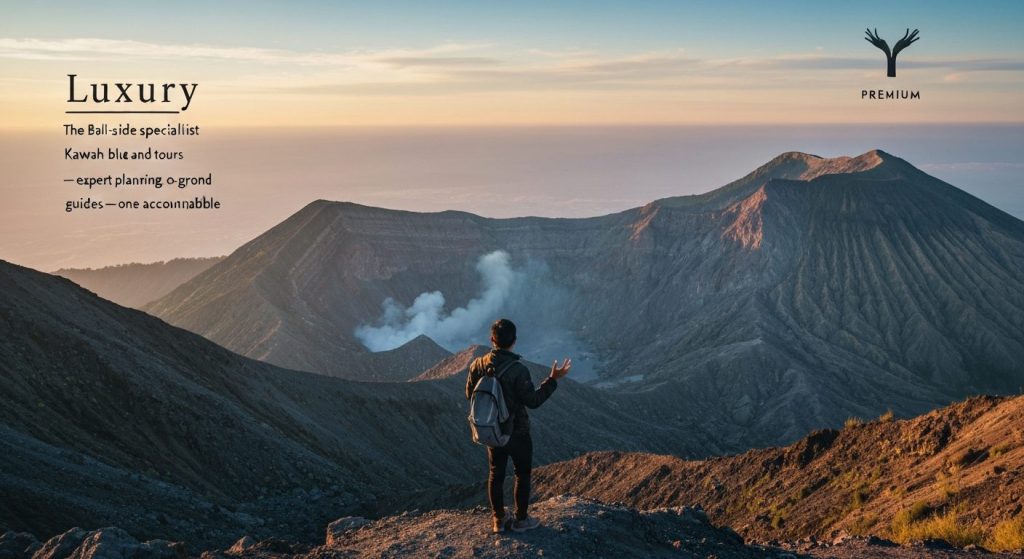
A `luxury ijen tour from bali` offers a uniquely tailored and deeply comfortable way to experience the iconic blue flames and the turquoise crater lake of Kawah Ijen. This isn’t just a trip; it’s a meticulously planned, all-inclusive concierge journey from the moment you leave your Bali accommodation until your return.
For those seeking an unforgettable adventure without the logistical headaches, a `luxury kawah ijen crater tour from bali` provides private guides, premium transfers, boutique hotel stays, and every permit or piece of equipment handled. It’s the difference between navigating a complex journey yourself and having a trusted friend in Bali orchestrate every detail, ensuring your focus remains entirely on the awe-inspiring natural spectacle.
What Defines a Luxury Ijen Tour from Bali?
When we talk about a `luxury ijen tour from bali`, we’re not just adding a premium price tag to a standard trek. We’re talking about a completely different class of experience, designed for comfort, exclusivity, and peace of mind. Our approach, through Bali Premium Trip, is about providing a seamless, high-quality adventure. Think of it as having your own personal travel architect.
The journey to Kawah Ijen is demanding. It involves a midnight departure, a ferry crossing, a drive up a winding mountain road, and a challenging hike in the dark. A luxury tour smooths out these rough edges. It means not worrying about finding a reliable driver in the middle of the night or haggling for a gas mask. It means having a comfortable vehicle waiting, a licensed guide who speaks your language, and a clean, restful boutique hotel room ready for you on Java.
Here’s a breakdown of what sets a Bali Premium Trip luxury Ijen tour apart:
- Private Transportation, Always.
- From your Bali hotel, you’ll travel in a comfortable, air-conditioned private vehicle. No shared vans, no waiting for other passengers. This extends to your transfers on Java, ensuring direct, efficient travel to the Ijen basecamp and your boutique accommodation.
- Expert, Licensed Local Guides.
- Our `ijen crater tour bali concierge` service ensures you have a vetted, licensed local guide. These aren’t just escorts; they are storytellers and navigators, intimately familiar with the mountain, its conditions, and its people. They guide you safely through the dark, explain the geology, and facilitate respectful interactions with the miners. Their local knowledge is invaluable.
- Premium Accommodation on Java.
- Unlike budget tours that might rush you back to Bali or offer basic stays, our `ijen tour with hotel accommodation` focuses on comfortable, boutique hotels in the Banyuwangi area. After a midnight hike, a clean bed, hot shower, and good breakfast are non-negotiable luxuries. This allows for proper rest before your return journey or onward travel to destinations like Bromo, making it ideal for a `couples romantic ijen tour bali` or `ijen honeymoon tour bali` where comfort is key.
- All Inclusions Handled.
- Gas masks, headlamps, park permits, ferry tickets, even bottled water and sometimes a packed breakfast – everything is pre-arranged and included. You won’t face unexpected costs or logistical hurdles. This truly makes it an `ijen tour all inclusive bali` experience.
- Seamless Ferry Crossing.
- The Ketapang-Gilimanuk ferry can be confusing. With Bali Premium Trip, your private driver manages the tickets and guides you through the process, ensuring a smooth and quick transition between Bali and Java.
Comparing Luxury vs. Standard Ijen Tours
To illustrate the difference, here’s a direct comparison of what you can expect from a `private luxury ijen blue fire tour` with Bali Premium Trip versus a typical budget or open-group tour:
| Feature | Luxury Private Concierge Tour (Bali Premium Trip) | Standard Budget/Open-Group Tour |
|---|---|---|
| Transportation from Bali | Private, air-conditioned car, direct hotel pickup. | Shared van/bus, multiple pickups, potentially long waits. |
| Ferry Crossing | Seamless, tickets handled, driver assists with boarding. | Self-managed tickets, navigating crowds, potential delays. |
| Accommodation on Java | Boutique hotel (e.g., Dialoog Banyuwangi, Ketapang Indah) with private bathroom, hot water, breakfast. | Basic guesthouse or hostel, shared facilities, no guaranteed comfort. |
| Guide Quality | Vetted, licensed, English-speaking local guide for your group. | Often a single guide for a large group, limited personal attention, variable language skills. |
| Inclusions | All permits, gas masks, headlamps, water, ferry tickets, tolls, driver, guide, boutique hotel. | Often excludes permits, gas masks (rental extra), headlamps, some meals, or specific transfers. |
| Pacing & Flexibility | Your pace, ability to linger at viewpoints, customized schedule. | Fixed schedule, often rushed, limited flexibility for individual needs. |
| Privacy & Exclusivity | Exclusive experience for your private group (couples, family). | Shared experience with strangers, less personal interaction. |
| Post-Hike Comfort | Return to a comfortable hotel for rest/shower before onward journey. | Direct return to Bali, potentially exhausted, or basic accommodation. |
| Price (Indicative, per person, 2D/1N) | US$450-800 (last verified June 2026, varies by season/hotel) | US$150-300 (often with hidden costs or lower quality inclusions) |
Capturing the Blue Fire: A Photographer’s Guide by Ijen Tour from Bali Editorial Desk
As the Photography & Night-Sky Field Editor for Ijen Tour From Bali, my job is to help visitors truly *see* and capture the magic of Kawah Ijen. The blue fire, in particular, is an elusive subject. It demands patience and specific camera settings in near-total darkness.
The blue fire is not actual lava; it’s ignited sulfuric gas. When sulfur comes into contact with the air at temperatures above 360°C (680°F), it ignites, burning with an electric blue flame. This phenomenon is best seen between 2 AM and 4 AM, before the first hint of dawn.
Camera Settings for Near-Total Darkness
Photographing the blue fire requires manual control. Forget auto mode; your camera won’t know what to do with such low light. Here’s what I recommend:
* **Tripod:** Absolutely essential. Handheld shots will be blurry due to long exposures. A sturdy tripod is your best friend.
* **Manual Mode (M):** You need full control.
* **Aperture (f-stop):** Go wide open, the smallest f-number your lens allows (e.g., f/2.8, f/4). This lets in maximum light.
* **ISO:** Start around ISO 1600-3200. You might need to push it higher (e.g., ISO 6400) depending on your camera’s low-light performance. Be mindful of noise at very high ISOs.
* **Shutter Speed:** This is key. The blue flames flicker, so you want to capture their movement without blowing out the highlights. Start with 10-20 seconds. If the flames are too bright, reduce the time. If they’re too faint, increase it. Experiment. I’ve found 15 seconds at f/2.8, ISO 3200 to be a good starting point with a full-frame sensor.
* **Focus:** Manual focus. In darkness, autofocus will struggle. Set your lens to infinity focus, or use your camera’s live view and zoom in on a distant light (like another headlamp or a bright star) to manually focus. Once set, don’t touch it.
* **White Balance:** Set to Tungsten or Fluorescent for a cooler tone, or manual Kelvin around 3200-4000K. Auto white balance can often misinterpret the blue light.
* **RAW Format:** Always shoot in RAW. This gives you much more flexibility in post-processing to recover details in shadows and highlights, and to adjust white balance precisely.
**Pro Tip:** Your guide will know the safest and best spots to view the blue fire. Listen to them. The air quality near the flames is poor, and you’ll need your gas mask properly fitted. Don’t rush. Take a few test shots, review them, and adjust your settings. Patience pays off.
The Turquoise Crater Lake at Sunrise: Where to Stand for the Best Shot
After witnessing the blue fire, the next spectacle is the sunrise illuminating Kawah Ijen’s incredible turquoise crater lake. This is a dramatic shift from darkness to vibrant color. The lake is the world’s largest highly acidic crater lake, a truly unique sight.
Where to Stand on the Rim at Sunrise
As dawn approaches, you’ll want to ascend from the blue fire area back to the crater rim. The climb out is steep, but the reward is immense.
* **East Rim (Primary Viewpoint):** The most common and accessible viewpoint is along the eastern edge of the crater rim, where the main hiking trail reaches the top. From here, you’ll have a sweeping panorama of the lake with the sun rising behind you, illuminating the entire scene.
* **Higher Ground on the East Rim:** If you’re willing to walk a bit further along the rim trail (always with your guide and exercising extreme caution due to unstable ground), you can find slightly higher vantage points that offer an even broader perspective. These spots are less crowded.
* **Framing the Miner’s Trail:** As the sun rises, the path the miners use, snaking down into the crater, becomes visible. This offers a fantastic compositional element, showcasing the human scale against the vast landscape. Look for angles that include the trail leading towards the lake.
* **Capture the Fumes:** The sulfurous fumes from the fumaroles (volcanic vents) often drift across the lake. These can create dramatic, ethereal effects in your photos, especially with the sunrise light filtering through them.
**Sunrise Settings:**
* **Aperture:** f/8 to f/11 for good depth of field, ensuring both foreground and background are sharp.
* **ISO:** As low as possible (e.g., ISO 100-400) as light increases.
* **Shutter Speed:** Adjust for proper exposure; it will be much faster than for the blue fire, likely in the range of 1/60th to 1/250th of a second.
* **White Balance:** Auto White Balance usually works well at sunrise, or experiment with “Cloudy” or “Shade” for warmer tones.
Remember, the light changes quickly at sunrise. Be ready to adjust your settings as the sun climbs higher.
Respectful Photography of the Sulfur Miners
The sulfur miners of Kawah Ijen are an integral part of the experience, and their work is incredibly arduous. It’s crucial to approach photographing them with respect and sensitivity. This is not a zoo; these are men (and occasionally women) performing back-breaking labor in harsh conditions.
Here’s how to photograph them respectfully:
1. **Ask for Permission:** This is paramount. A simple “Boleh saya ambil foto?” (May I take a photo?) or a gesture with your camera, followed by a polite “Terima kasih” (Thank you), goes a long way. Your guide can help translate. If they decline, respect their decision immediately.
2. **Offer a Small Token:** It’s common practice, and a kind gesture, to offer a small amount of money (e.g., 5,000-10,000 IDR) or a cigarette if they smoke, *after* you’ve taken their photo and they’ve agreed. This is not a payment for a pose, but a recognition of their difficult work and their time.
3. **Be Discreet:** Don’t shove your camera in their faces. Use a telephoto lens if you have one, or keep a respectful distance. Capture them in their environment, working, rather than demanding posed shots.
4. **Focus on the Action, Not Just the Face:** Photograph them loading sulfur, carrying baskets, or navigating the treacherous paths. This tells a more complete and dignified story of their work.
5. **Avoid Glorifying Hardship:** The goal is to document their reality, not to create exploitative or overly dramatic images. Focus on the strength and resilience, the human element.
6. **Safety First:** Always prioritize your safety and theirs. Do not impede their work or block their path. The trails are narrow, and they are carrying heavy loads (often 70-90 kg of sulfur). Step aside and give them plenty of space.
Our `private luxury ijen blue fire tour` guides are experienced in facilitating these interactions respectfully. They understand the local customs and can help you communicate your intentions appropriately.
Best Season and Weather Windows for Blue Fire Visibility
The visibility of the blue fire and the overall enjoyment of your Kawah Ijen experience are highly dependent on the season and weather. As Ijen Tour from Bali Editorial Desk, I’ve spent countless nights on that mountain, and I can tell you, timing matters.
The Dry Season: Best for Blue Fire and Clear Skies
* **Months:** Generally, **April to October** is the dry season in East Java.
* **Blue Fire Visibility:** This is hands down the best time. Less rain means clearer skies, less cloud cover, and significantly reduced chances of fog. Fog can obscure the blue flames and the crater lake entirely.
* **Hiking Conditions:** Trails are drier, less slippery, and more comfortable to navigate.
* **Sunrise Views:** You have the highest probability of a clear, spectacular sunrise over the turquoise lake.
* **Crowds:** Expect more visitors during the peak dry season months (July-August), especially around public holidays. However, our `ijen tour all inclusive bali` ensures your experience remains private and exclusive, regardless of general crowd levels.
The Wet Season: Higher Risk, But Still Possible
* **Months:** **November to March** is the wet season.
* **Blue Fire Visibility:** Rain and heavy cloud cover are more frequent. This can dramatically reduce visibility of the blue fire and the sunrise. Fog is a common occurrence.
* **Hiking Conditions:** Trails can be muddy, slippery, and more challenging.
* **Crowds:** Generally fewer tourists, which can mean a more solitary experience on days with good weather.
* **Recommendation:** While possible, if your primary goal is blue fire photography or guaranteed clear views, the wet season carries a higher risk of disappointment. We always recommend flexible travel dates within the dry season if possible.
**Weather Windows:**
Even within the best season, check the local weather forecast for Banyuwangi a few days before your trip. Look for clear night skies and minimal wind. Strong winds can disperse the sulfur gas, making the flames less concentrated, though this is less common.
Our Bali Premium Trip team constantly monitors local conditions and communicates any significant changes that might affect your `luxury ijen tour from bali`. We prioritize your safety and experience above all else.
Plan Your Exclusive Kawah Ijen Trip Today
Logistics: From Bali to Kawah Ijen
The journey from Bali to Kawah Ijen involves several stages, often beginning in the middle of the night. Understanding the sequence helps manage expectations for your `ijen tour with hotel pickup and transfer`.
The Midnight Departure from Bali
Your `ijen tour with hotel pickup and transfer` typically starts between 11 PM and 12 AM from your Bali accommodation. This early start is crucial to reach the Ketapang ferry port in Gilimanuk, West Bali, in time for the ferry crossing to Java, and then drive to the Ijen basecamp for the pre-dawn hike to the blue fire.
The Ferry Crossing to Java
The ferry crossing from Gilimanuk (Bali) to Ketapang (Java) takes approximately 45-60 minutes. Our private drivers handle all tickets and guide you through the process, which can be busy. This is where the `ijen crater tour bali concierge` service truly shines, making a potentially stressful transition smooth and effortless.
Drive to Ijen Basecamp (Paltuding)
From Ketapang, it’s about a 1.5 to 2-hour drive up winding mountain roads to the Paltuding basecamp, the starting point for the Kawah Ijen trek. You’ll likely arrive around 2 AM, just in time to begin the ascent.
The Hike to the Crater Rim and Blue Fire
The trek from Paltuding to the crater rim is approximately 3 kilometers (about 1.9 miles) and takes 1.5 to 2 hours, depending on your fitness level. The path is well-maintained but steep in sections. Once at the rim, the descent into the crater to see the blue fire is another ~800 meters (about 0.5 miles) down a very rocky, uneven path. This part is particularly challenging and requires good balance and sturdy footwear.
Fitness and Safety Considerations
* **Fitness Level:** A moderate level of fitness is required. You don’t need to be an athlete, but you should be able to walk uphill for extended periods. If you have knee issues or respiratory problems, consult your doctor before booking.
* **Gas Masks:** Essential for protection against sulfur fumes, especially near the blue fire and within the crater. Our `private luxury ijen blue fire tour` includes high-quality, properly fitted gas masks.
* **Footwear:** Sturdy hiking shoes with good grip are non-negotiable. The trails can be slippery and rocky.
* **Warm Clothing:** It gets very cold at the Ijen crater (around 5-10°C or 40-50°F) before dawn. Layered clothing, a warm jacket, hat, and gloves are highly recommended.
* **Headlamp:** Crucial for navigating in the dark. Provided as part of our `all inclusive ijen tour packages price`.
* **Hydration:** Bring water. You’ll be exerting yourself.
Upon returning to the basecamp after the hike and sunrise, you’ll be transferred to your boutique hotel in Banyuwangi for a well-deserved rest, breakfast, and shower.
Why Choose Ijen Tour From Bali for Your Luxury Kawah Ijen Experience?
Ijen Tour From Bali, powered by Bali Premium Trip, is your direct link to a truly premium Kawah Ijen experience. We’re not an anonymous booking agent. We are a Bali-based team, deeply familiar with the region, committed to providing concierge-grade service.
Here’s why we stand out for your `exclusive bromo ijen tour with boutique hotels` or a standalone Ijen adventure:
* **One Accountable Team from Bali to the Rim:** You deal with us, Bali Premium Trip, directly. From your initial inquiry to your return to Bali, we manage every aspect. There’s no third-party confusion. We arrange all ground transportation, ferry crossings, and select boutique hotel stays. While park permits and local guiding services are handled by our vetted, licensed local partners on Java, your entire journey is overseen by our single, accountable team. This ensures consistency and quality.
* **Expert Planning, Zero Logistics:** We handle everything. Permits, gas masks, headlamps, private vehicles, ferry tickets, boutique hotels – it’s all taken care of. Your job is to enjoy the journey.
* **”Luxury Done Honestly”:** We provide transparent pricing and clear inclusions. You won’t find hidden fees or unpleasant surprises. We contrast our `all inclusive ijen tour packages price` with budget options, not to disparage them, but to clearly outline the value and comfort difference.
* **Vetted Local Expertise:** Our local guides on Java are not just guides; they are experienced, licensed professionals who know Kawah Ijen intimately. They prioritize your safety, share local insights, and enhance your understanding of the incredible environment and the lives of the sulfur miners.
* **Perfect for Couples and Honeymooners:** Our private, exclusive tours are ideal for a `couples romantic ijen tour bali` or `ijen honeymoon tour bali`, offering privacy, comfort, and unforgettable shared experiences without the stress of planning.
We believe in providing honest advice, vivid descriptions, and precise details about everything from ferry timings to fitness levels. We never hype, never make a fabricated promise. We’re your trail-tested friends, sharing the honest truth about this extraordinary adventure.
Ijen Tour Packages Price & What to Expect
The `all inclusive ijen tour packages price` for a luxury experience with Bali Premium Trip reflects the comprehensive service, premium inclusions, and peace of mind you receive. This isn’t just about getting to the mountain; it’s about the quality of the journey, the comfort of your rest, and the expertise of your guides.
**Indicative Price Range (Last Verified June 2026):**
For a 2-day, 1-night `luxury ijen tour from bali` including private transfers from Bali, return ferry tickets, a quality boutique hotel stay (e.g., Dialoog Banyuwangi or similar) with breakfast, all park permits, a licensed local guide, gas mask, and headlamp, you can expect an indicative price range of **US$450 – US$800 per person**.
* **Variations:** This range can vary based on:
* **Number of Travelers:** Prices are often more cost-effective per person for groups of 2-4.
* **Seasonality:** Peak dry season may see slightly higher rates.
* **Hotel Choice:** Upgrading to a more exclusive boutique hotel on Java will affect the price.
* **Duration:** Multi-day tours that combine Ijen with other destinations like Mount Bromo (an `exclusive bromo ijen tour with boutique hotels`) will naturally be higher. For example, a 3-day, 2-night Bromo-Ijen luxury tour might range from **US$800 – US$1,500 per person**, depending on inclusions and hotels.
**What’s Included at This Price Point:**
* Private, air-conditioned vehicle transfers from your Bali hotel to Gilimanuk port (return).
* Round-trip ferry tickets (Gilimanuk-Ketapang).
* Private, air-conditioned vehicle transfers on Java (Ketapang to Ijen basecamp, hotel, etc.).
* 1-night stay at a carefully selected boutique hotel in Banyuwangi (e.g., Dialoog Banyuwangi, Ketapang Indah Hotel, or similar), including breakfast.
* Licensed, experienced English-speaking local Ijen guide.
* Kawah Ijen National Park entrance fees and blue fire permit.
* High-quality gas mask rental.
* Headlamp rental.
* Bottled mineral water during the tour.
* All applicable taxes and service charges.
Booking directly with our Bali Premium Trip reservations team ensures you receive transparent, published rates with no third-party markup.
Frequently Asked Questions
Is Kawah Ijen suitable for young children?
The Kawah Ijen trek is physically demanding, involving a midnight start, a steep uphill hike in the dark, and a challenging descent into the crater. Due to the sulfur fumes, the need for a gas mask, and the overall arduous nature of the journey, it is generally not recommended for children under 10-12 years old. Older children who are fit and accustomed to hiking may be able to manage, but parental discretion and a discussion with our team are advised.
What should I pack for the Ijen tour?
Pack layers of warm clothing (jacket, hat, gloves), a comfortable backpack, sturdy hiking shoes with good grip, a reusable water bottle, some snacks, personal medications, and a small towel. While we provide headlamps and gas masks, some travelers prefer to bring their own if they have them. Don’t forget your camera gear, including a tripod if you plan to photograph the blue fire.
How fit do I need to be for the Ijen trek?
You should have a moderate level of fitness. The hike to the crater rim is approximately 3 km (1.9 miles) one way, with an elevation gain of around 450 meters (1,475 feet), taking 1.5 to 2 hours. The descent into the crater for the blue fire is another ~800 meters (0.5 miles) down a very uneven, rocky path. If you can comfortably walk uphill for a few hours, you should be fine. Regular exercise beforehand will certainly help.
Can I combine the Ijen tour with Mount Bromo?
Yes, absolutely! Many travelers choose to combine a `luxury kawah ijen crater tour from bali` with a visit to Mount Bromo, creating an `exclusive bromo ijen tour with boutique hotels`. This typically involves an extra night or two on Java. Our Bali Premium Trip team can expertly plan seamless transfers and boutique hotel stays for a combined Bromo-Ijen itinerary, ensuring you get the most out of your East Java adventure.
Is it safe to go down into the crater to see the blue fire?
Going into the crater to see the blue fire is a challenging and potentially hazardous activity. It requires navigating a steep, rocky, and often slippery path in the dark, with limited visibility due to sulfur fumes. Your licensed local guide will assess conditions on the night and advise on the safest approach. Wearing a properly fitted gas mask is mandatory for protection against the highly concentrated sulfur dioxide gas. We prioritize your safety, and our guides are trained to lead you through this experience as safely as possible, but personal caution is always required.
Ready for an unforgettable journey? Our team at Bali Premium Trip is here to help you design your perfect `luxury ijen tour from bali`. Experience the blue fire and the turquoise crater lake with comfort, confidence, and expert guidance.
You can also reach out to us via WhatsApp for quick planning and personalized assistance. We’re here to make your Kawah Ijen adventure truly exceptional.